XDR-Analyst套裝 & XDR-Analyst考試證照綜述
Wiki Article
從Google Drive中免費下載最新的Fast2test XDR-Analyst PDF版考試題庫:https://drive.google.com/open?id=1XwwJzv3ZPc7mqxLXmqtdgsXUcnPnmmtS
如果你還在猶豫是否選擇Fast2test,你可以先到Fast2test網站下載我們免費提供的部分考試練習題和答案來確定我們的可靠性。如果你選擇下載我們的提供的所有考試練習題和答案,Fast2test敢100%保證你可以以高分數一次性通過Palo Alto Networks XDR-Analyst 認證考試。
選擇我們Fast2test就是選擇成功!Fast2test為你提供的Palo Alto Networks XDR-Analyst 認證考試的練習題和答案能使你順利通過考試。Palo Alto Networks XDR-Analyst 認證考試的考試之前的模擬考試時很有必要的,也是很有效的。如果你選擇了Fast2test,你可以100%通過考試。
Palo Alto Networks XDR-Analyst考試證照綜述 - XDR-Analyst權威考題
獲得XDR-Analyst認證已經成為大多數IT員工獲得更好工作的一種選擇,然而,許多考生一直在努力嘗試卻失敗了。如果你選擇使用我們的Palo Alto Networks XDR-Analyst題庫產品,幫您最大程度保證取得成功。充分利用XDR-Analyst題庫你將得到不一樣的效果,這是一個針對性強,覆蓋面廣,更新快,最完整的學習資料,保證您一次通過XDR-Analyst考試。如果您想要真實的考試模擬,就選擇我們軟件版本的Palo Alto Networks XDR-Analyst題庫,安裝在電腦上進行模擬,簡單易操作。
Palo Alto Networks XDR-Analyst 考試大綱:
| 主題 | 簡介 |
|---|---|
| 主題 1 |
|
| 主題 2 |
|
| 主題 3 |
|
| 主題 4 |
|
最新的 Security Operations XDR-Analyst 免費考試真題 (Q73-Q78):
問題 #73
Under which conditions is Local Analysis evoked to evaluate a file before the file is allowed to run?
- A. The endpoint is disconnected or the verdict from WildFire is of a type unknown.
- B. The endpoint is disconnected or the verdict from WildFire is of a type benign.
- C. The endpoint is disconnected or the verdict from WildFire is of a type malware.
- D. The endpoint is disconnected or the verdict from WildFire is of a type grayware.
答案:A
解題說明:
Local Analysis is a feature of Cortex XDR that allows the agent to evaluate files locally on the endpoint, without sending them to WildFire for analysis. Local Analysis is evoked when the following conditions are met:
The endpoint is disconnected from the internet or the Cortex XDR management console, and therefore cannot communicate with WildFire.
The verdict from WildFire is of a type unknown, meaning that WildFire has not yet analyzed the file or has not reached a conclusive verdict.
Local Analysis uses machine learning models to assess the behavior and characteristics of the file and assign it a verdict of either benign, malware, or grayware. If the verdict is malware or grayware, the agent will block the file from running and report it to the Cortex XDR management console. If the verdict is benign, the agent will allow the file to run and report it to the Cortex XDR management console. Reference:
Local Analysis
WildFire File Verdicts
問題 #74
A Linux endpoint with a Cortex XDR Pro per Endpoint license and Enhanced Endpoint Data enabled has reported malicious activity, resulting in the creation of a file that you wish to delete. Which action could you take to delete the file?
- A. Open an NFS connection from the Cortex XDR console and delete the file.
- B. Initiate Remediate Suggestions to automatically delete the file.
- C. Manually remediate the problem on the endpoint in question.
- D. Open X2go from the Cortex XDR console and delete the file via X2go.
答案:B
解題說明:
The best action to delete the file on the Linux endpoint is to initiate Remediation Suggestions from the Cortex XDR console. Remediation Suggestions are a feature of Cortex XDR that provide you with recommended actions to undo the effects of malicious activity on your endpoints. You can view the remediation suggestions for each alert or incident in the Cortex XDR console, and decide whether to apply them or not. Remediation Suggestions can help you restore the endpoint to its original state, remove malicious files or processes, or fix registry or system settings. Remediation Suggestions are based on the forensic data collected by the Cortex XDR agent and the analysis performed by Cortex XDR.
The other options are incorrect for the following reasons:
A is incorrect because manually remediating the problem on the endpoint is not a convenient or efficient way to delete the file. Manually remediating the problem would require you to access the endpoint directly, log in as root, locate the file, and delete it. This would also require you to have the necessary permissions and credentials to access the endpoint, and to know the exact path and name of the file. Manually remediating the problem would also not provide you with any audit trail or confirmation of the deletion.
B is incorrect because opening X2go from the Cortex XDR console is not a supported or secure way to delete the file. X2go is a third-party remote desktop software that allows you to access Linux endpoints from a graphical user interface. However, X2go is not integrated with Cortex XDR, and using it would require you to install and configure it on both the Cortex XDR console and the endpoint. Using X2go would also expose the endpoint to potential network attacks or unauthorized access, and would not provide you with any audit trail or confirmation of the deletion.
D is incorrect because opening an NFS connection from the Cortex XDR console is not a feasible or reliable way to delete the file. NFS is a network file system protocol that allows you to access files on remote servers as if they were local. However, NFS is not integrated with Cortex XDR, and using it would require you to set up and maintain an NFS server and client on both the Cortex XDR console and the endpoint. Using NFS would also depend on the network availability and performance, and would not provide you with any audit trail or confirmation of the deletion.
Reference:
Remediation Suggestions
Apply Remediation Suggestions
問題 #75
As a Malware Analyst working with Cortex XDR you notice an alert suggesting that there was a prevented attempt to download Cobalt Strike on one of your servers. Days later, you learn about a massive ongoing supply chain attack. Using Cortex XDR you recognize that your server was compromised by the attack and that Cortex XDR prevented it. What steps can you take to ensure that the same protection is extended to all your servers?
- A. Enable Behavioral Threat Protection (BTP) with cytool to prevent the attack from spreading.
- B. Create IOCs of the malicious files you have found to prevent their execution.
- C. Create Behavioral Threat Protection (BTP) rules to recognize and prevent the activity.
- D. Enable DLL Protection on all servers but there might be some false positives.
答案:C
解題說明:
To ensure that the same protection is extended to all your servers, you need to create Behavioral Threat Protection (BTP) rules to recognize and prevent the activity. BTP is a feature of Cortex XDR that allows you to create custom rules that detect and block malicious or suspicious behaviors on your endpoints, such as file execution, process injection, network connection, or registry modification. BTP rules can use various operators, functions, and variables to define the criteria and the actions for the rules. By creating BTP rules that match the behaviors of the supply chain attack, you can prevent the attack from compromising your servers12.
Let's briefly discuss the other options to provide a comprehensive explanation:
B . Enable DLL Protection on all servers but there might be some false positives: This is not the correct answer. Enabling DLL Protection on all servers will not ensure that the same protection is extended to all your servers. DLL Protection is a feature of Cortex XDR that allows you to block the execution of unsigned or untrusted DLL files on your endpoints. DLL Protection can help to prevent some types of attacks that use malicious DLL files, but it may not be effective against the supply chain attack that used a Trojanized DLL file that was digitally signed by a trusted vendor. DLL Protection may also cause some false positives, as it may block some legitimate DLL files that are unsigned or untrusted3.
C . Create IOCs of the malicious files you have found to prevent their execution: This is not the correct answer. Creating IOCs of the malicious files you have found will not ensure that the same protection is extended to all your servers. IOCs are indicators of compromise that you can create to detect and respond to known threats on your endpoints, such as file hashes, registry keys, IP addresses, domain names, or full paths. IOCs can help to identify and block the malicious files that you have already discovered, but they may not be effective against the supply chain attack that used different variants of the malicious files with different hashes or names. IOCs may also become outdated, as the attackers may change or update their files to evade detection4.
D . Enable Behavioral Threat Protection (BTP) with cytool to prevent the attack from spreading: This is not the correct answer. Enabling BTP with cytool will not ensure that the same protection is extended to all your servers. BTP is a feature of Cortex XDR that allows you to create custom rules that detect and block malicious or suspicious behaviors on your endpoints, such as file execution, process injection, network connection, or registry modification. BTP rules can help to prevent the attack from spreading, but they need to be created and configured in the Cortex XDR app, not with cytool. Cytool is a command-line tool that allows you to perform various operations on the Cortex XDR agent, such as installing, uninstalling, upgrading, or troubleshooting. Cytool does not have an option to enable or configure BTP rules.
In conclusion, to ensure that the same protection is extended to all your servers, you need to create BTP rules to recognize and prevent the activity. By using BTP rules, you can create custom and flexible prevention rules that match the behaviors of the supply chain attack.
Reference:
Behavioral Threat Protection
Create a BTP Rule
DLL Protection
Create an IOC Rule
[Cytool]
問題 #76
Which version of python is used in live terminal?
- A. Python 2 and 3 with standard Python libraries
- B. Python 3 with specific XDR Python libraries developed by Palo Alto Networks
- C. Python 2 and 3 with specific XDR Python libraries developed by Palo Alto Networks
- D. Python 3 with standard Python libraries
答案:D
解題說明:
Live terminal uses Python 3 with standard Python libraries to run Python commands and scripts on the endpoint. Live terminal does not support Python 2 or any custom or external Python libraries. Live terminal uses the Python interpreter embedded in the Cortex XDR agent, which is based on Python 3.7.4. The standard Python libraries are the modules that are included with the Python installation and provide a wide range of functionalities, such as operating system interfaces, network programming, data processing, and more. You can use the Python commands and scripts to perform advanced tasks or automation on the endpoint, such as querying system information, modifying files or registry keys, or running other applications. Reference:
Run Python Commands and Scripts
Python Standard Library
問題 #77
Which statement is correct based on the report output below?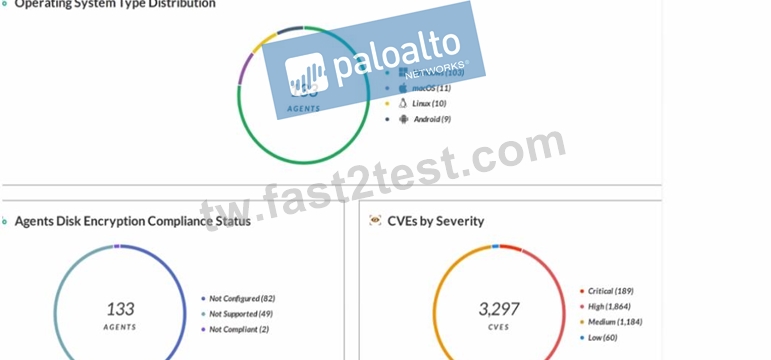
- A. 133 agents have full disk encryption.
- B. Host Inventory Data Collection is enabled.
- C. 3,297 total incidents have been detected.
- D. Forensic inventory data collection is enabled.
答案:D
解題說明:
The report output shows the number of endpoints that have forensic inventory data collection enabled, which is a feature of Cortex XDR that allows the collection of detailed information about the endpoint's hardware, software, and network configuration. This feature helps analysts to investigate and respond to incidents more effectively by providing a comprehensive view of the endpoint's state and activity. Forensic inventory data collection can be enabled or disabled per policy in Cortex XDR. Reference:
Forensic Inventory Data Collection
Cortex XDR 3: Getting Started with Endpoint Protection
問題 #78
......
手上能拿到一些實用的認證證書,無疑為自己的就業開拓了一番新的領土和創造了一些機會。XDR-Analyst 是全球最大的網絡設備公司 Palo Alto Networks 公司的認可的初級技術認證,在整個 Palo Alto Networks 認證體系中處于售前規劃方向的基礎證書,有了XDR-Analyst 認證你的平均年薪將不低于10萬人民幣。雖然獲取 XDR-Analyst 認證需要投入額外的時間與金錢,但事實證明IT認證的投入產出是值得的,對於未來的職業發展非常有利。
XDR-Analyst考試證照綜述: https://tw.fast2test.com/XDR-Analyst-premium-file.html
- XDR-Analyst套裝 100%通過|最新的Palo Alto Networks XDR Analyst考試證照綜述確保通過 ???? 立即到✔ www.kaoguti.com ️✔️上搜索( XDR-Analyst )以獲取免費下載XDR-Analyst PDF
- 免費PDF Palo Alto Networks XDR-Analyst:Palo Alto Networks XDR Analyst套裝 - 最佳的Newdumpspdf XDR-Analyst考試證照綜述 ???? 立即到✔ www.newdumpspdf.com ️✔️上搜索➡ XDR-Analyst ️⬅️以獲取免費下載XDR-Analyst下載
- XDR-Analyst真題 ???? XDR-Analyst證照指南 ???? XDR-Analyst測試引擎 ♿ 複製網址▷ tw.fast2test.com ◁打開並搜索[ XDR-Analyst ]免費下載XDR-Analyst認證考試
- XDR-Analyst PDF ???? 最新XDR-Analyst試題 ???? XDR-Analyst資料 ???? ▷ www.newdumpspdf.com ◁提供免費☀ XDR-Analyst ️☀️問題收集XDR-Analyst測試引擎
- XDR-Analyst最新題庫資源 ???? XDR-Analyst最新考古題 ???? XDR-Analyst考古題分享 ???? 在《 www.newdumpspdf.com 》上搜索{ XDR-Analyst }並獲取免費下載XDR-Analyst測試引擎
- 最新有效的XDR-Analyst學習指南資料 - 提供免费的XDR-Analyst試題下載 ???? 立即打開《 www.newdumpspdf.com 》並搜索[ XDR-Analyst ]以獲取免費下載XDR-Analyst資料
- XDR-Analyst下載 ???? XDR-Analyst考題寶典 ✔ XDR-Analyst下載 ???? ➥ www.newdumpspdf.com ????最新⏩ XDR-Analyst ⏪問題集合XDR-Analyst在線題庫
- XDR-Analyst套裝,Palo Alto Networks XDR Analyst XDR-Analyst考試證照綜述 ???? 在➥ www.newdumpspdf.com ????上搜索“ XDR-Analyst ”並獲取免費下載XDR-Analyst下載
- 最受推薦的的XDR-Analyst套裝,覆蓋大量的Palo Alto Networks認證XDR-Analyst考試知識點 ???? 到▷ www.newdumpspdf.com ◁搜尋「 XDR-Analyst 」以獲取免費下載考試資料XDR-Analyst題庫
- 最新的XDR-Analyst套裝和資格考試中的領先提供商和無與倫比的XDR-Analyst:Palo Alto Networks XDR Analyst ???? 免費下載☀ XDR-Analyst ️☀️只需進入✔ www.newdumpspdf.com ️✔️網站XDR-Analyst參考資料
- XDR-Analyst套裝,Palo Alto Networks XDR Analyst XDR-Analyst考試證照綜述 ???? 到【 www.pdfexamdumps.com 】搜索⮆ XDR-Analyst ⮄輕鬆取得免費下載最新XDR-Analyst試題
- lingeriebookmark.com, haseebidxt313562.theideasblog.com, anyabeaf089568.signalwiki.com, tools-directory.com, macrobookmarks.com, thefairlist.com, bookmarks-hit.com, emiliaqzxw913612.wikiconversation.com, dailybookmarkhit.com, bookmarktune.com, Disposable vapes
P.S. Fast2test在Google Drive上分享了免費的、最新的XDR-Analyst考試題庫:https://drive.google.com/open?id=1XwwJzv3ZPc7mqxLXmqtdgsXUcnPnmmtS
Report this wiki page